

Overview
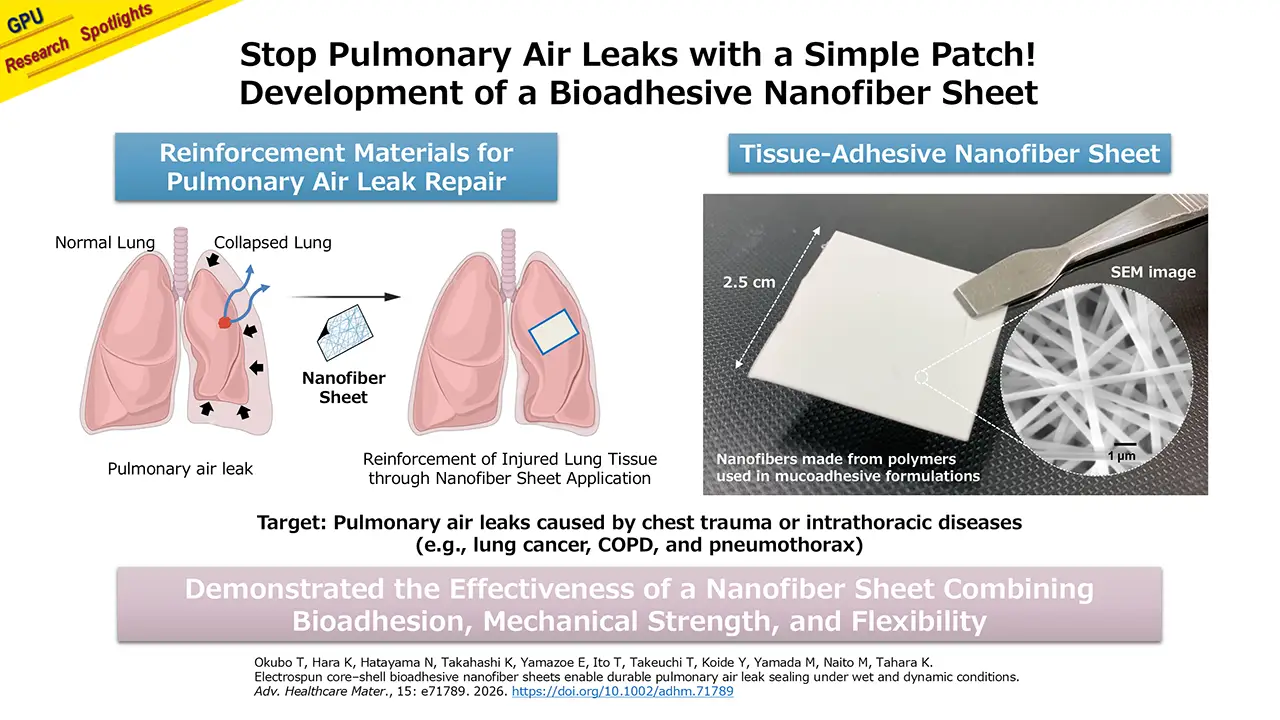
A collaborative research team from Gifu Pharmaceutical University (Laboratory of Pharmaceutical Engineering and Laboratory of Nanofiber Technology), Aichi Medical University (Department of Anatomy), and Mitsubishi Chemical Corporation has developed a novel bioadhesive nanofiber sheet capable of sealing pulmonary air leaks.
Pneumothorax is a condition in which air escapes from the lung, causing it to collapse. It can affect people of all ages, from young adults to older individuals. Pulmonary air leaks can also occur from lung resection surfaces or damaged lung tissue following pulmonary surgery, including surgery for lung cancer. Persistent air leaks can prolong hospitalization and increase the physical and psychological burden on patients, making reliable air leak sealing essential.
In conventional approaches to pulmonary air leak sealing, biologically derived adhesives, such as fibrin glue, and tissue reinforcement sheets are commonly used. However, because the lung surface is constantly wet and repeatedly expands and contracts during breathing, maintaining sufficient adhesion and sealing performance remains a challenge.
In this study, the researchers fabricated nanofiber sheets composed of extremely fine fibers, several hundred nanometers in diameter, using electrospinning technology. In particular, they adopted a core-shell structure, in which different polymer materials form the inner core and outer shell of each fiber, to achieve both tissue adhesion and durability in wet environments. Furthermore, by sequentially applying an adhesive sheet and a second sheet designed to improve durability, the researchers developed a technique capable of sealing pulmonary air leaks using the nanofiber sheets alone, without the need for biologically derived adhesives (Figure 1).
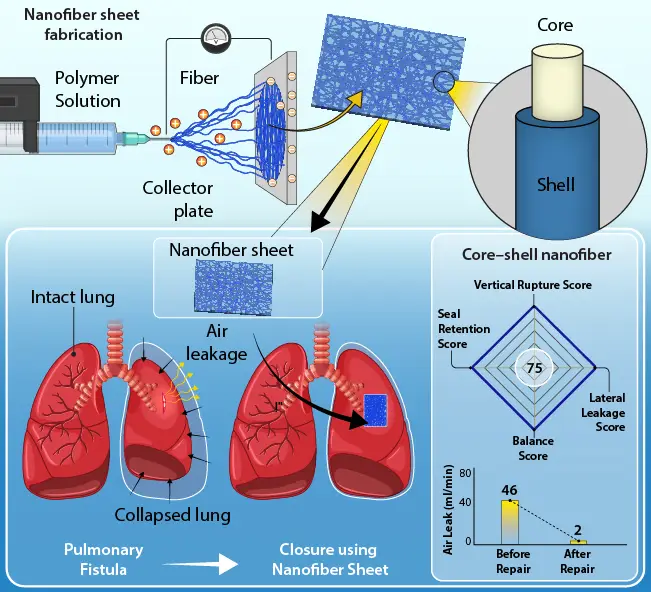
Figure 1. Overview of the study
The sheets were evaluated in a canine model of pulmonary air leakage using beagle dogs. All five cases met the predefined criteria for successful air leak sealing, and the mean air leakage rate decreased from 46.2 mL/min to 1.8 mL/min. Furthermore, no apparent material-related complications were observed during the one-month postoperative follow-up period.
These findings may contribute to the development of a new treatment for pulmonary air leaks following lung surgery, with potential future applications in conditions such as spontaneous pneumothorax. The research team will conduct further evaluations of efficacy and safety, aiming toward the practical development of the technology as a medical device.
The findings were published in the international scientific journal Advanced Healthcare Materials through a collaborative study involving Professor Kohei Tahara of Gifu Pharmaceutical University, Assistant Professor Tomohito Okubo and Professor Munekazu Naito of Aichi Medical University, and Mr. Kouji Hara of Mitsubishi Chemical Corporation, together with their colleagues.
Key Findings
1. Development of a novel pulmonary air leak sealant that does not require biologically derived adhesives
By using nanofiber sheets composed of synthetic polymers, including polyvinyl alcohol (PVA), the researchers developed a technique for sealing pulmonary air leaks without relying on conventional fibrin glue.
2. Combining tissue adhesion and water resistance through a core-shell structure (Figure 2)
By combining hydrophilic polymers that readily adhere to tissue with biodegradable polymers exhibiting excellent water resistance, the researchers developed nanofiber sheets capable of maintaining their sealing performance under wet conditions.
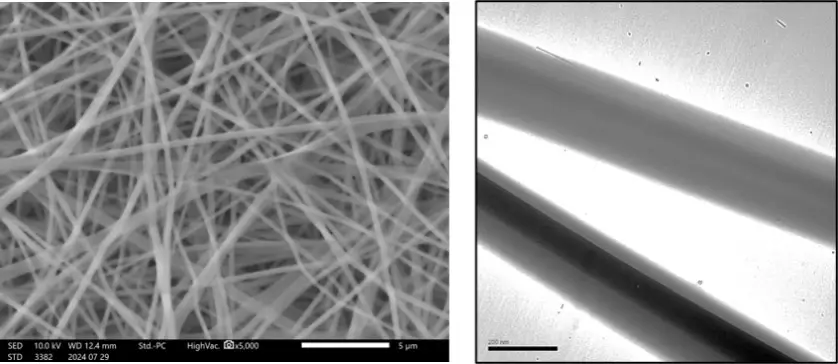
Figure 2. Electron microscopy images of core-shell nanofibers
Left: Scanning electron microscopy (SEM) image showing the interconnected network of nanofibers. Scale bar: 5 µm.
Right: Transmission electron microscopy (TEM) image showing the two-layer structure consisting of an inner core and an outer shell. Scale bar: 200 nm.
3. Demonstration of pulmonary air leak sealing in an animal model, supporting future medical device development
All five cases in the beagle canine model of pulmonary air leakage met the predefined criteria for successful sealing. These findings suggest the potential of the nanofiber sheets as a new treatment material for pulmonary air leaks following lung surgery and for conditions such as spontaneous pneumothorax.
Research Funding
This research was supported by the FY2024 Fujita Research and Development Program (Seeds A-equivalent) of Fujita Health University and the FY2025 Medical Device Research Results Translation Program (Challenge Type) of the Japan Agency for Medical Research and Development (AMED).
Publication Information
Journal: Advanced Healthcare Materials
Article Title: Electrospun Core-Shell Bioadhesive Nanofiber Sheets Enable Durable Pulmonary Air Leak Sealing Under Wet and Dynamic Conditions
Authors: Tomohito Okubo, Kouji Hara, Naoyuki Hatayama, Kota Takahashi, Eriko Yamazoe, Takaaki Ito, Takao Takeuchi, Yoko Koide, Mayumi Yamada, Munekazu Naito, Kohei Tahara
DOI: https://doi.org/10.1002/adhm.71789
Laboratory Websites
Laboratory of Pharmaceutical Engineering: https://gpu-seizai.jp/
Laboratory of Nanofiber Technology: https://gpu-nanofiber.jp/