

Abstract
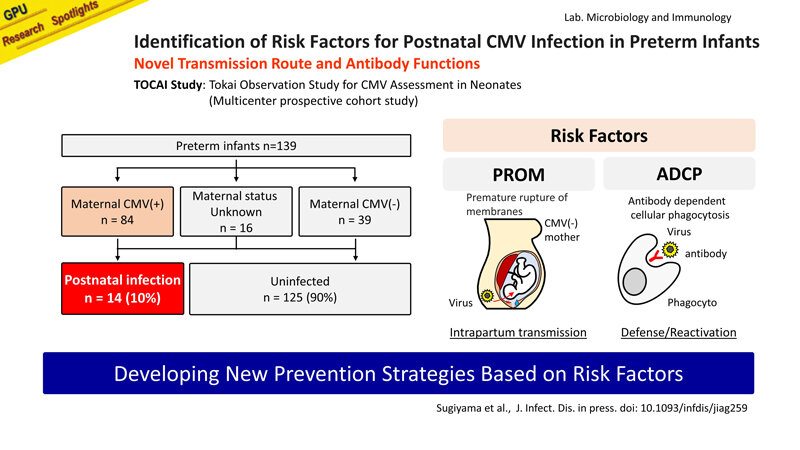
Postnatal cytomegalovirus (pCMV) infection is a major concern in extremely preterm infants to leads various manifestations, including sepsis-like illness and neurological symptoms. We identified novel risk factors of pCMV through TOCAI study- a multicenter prospective cohort study including extremely preterm infants and their mothers. Prolonged premature rupture of membranes (PROM) and antibody dependent cellular phagocytosis (ADCP) were significantly correlated with transmission of CMV to infants. Our findings reveal that the "novel transmission route" and the 'quality of immunity" drives the risk of infection from mothers to preterm infants. These findings provide crucial insights that directly contribute to the early identification of high-risk infants and the development of novel preventive strategies.
Our research was conducted as a multicenter prospective cohort study(Tokai Observational Study for CMV Assessment In Neonates, TOCAI Study)involving the following members.
Yuichiro Sugiyama, MD, PhD
Department of Pediatrics, Japanese Red Cross Aichi Medical Center Nagoya Daiichi Hospital.
Yuka Torii, MD, PhD
Department of Pediatrics, Nagoya University Graduate School of Medicine.
Ryuichi Tanaka, MD, PhD
Division of Neonatology, Center for Maternal-Neonatal Care, Nagoya University Hospital.
Takao Suzuki, MD, PhD
Department of Pediatrics, Anjo Kosei Hospital.
Tetsuo Koshizuka, PhD
Department of Microbiology and Immunology, Gifu Pharmaceutical University.
Our study was selected as the Editor's Choice in The Journal of Infectious Disease on May 9, 2026.
Background: Postnatal CMV infection as a serious threat to preterm infants
Cytomegalovirus (CMV) is one of the most common viruses, infecting the majority of healthy individuals asymptomatically. However, CMV transmission to preterm infants born at less than 28 weeks of gestational age (GA) postnatally (postnatal CMV infection, pCMV) an cause various symptoms, including sepsis-like illness, neutropenia, and neurological manifestations. We conducted a multicenter prospective cohort study (the TOCAI Study) enrolling 139 preterm infants and their mother, and identified 14 pCMV cases (10%).
Key Finding 1: Antibody quality, rather than quantity, is crucial for blocking pCMV infection
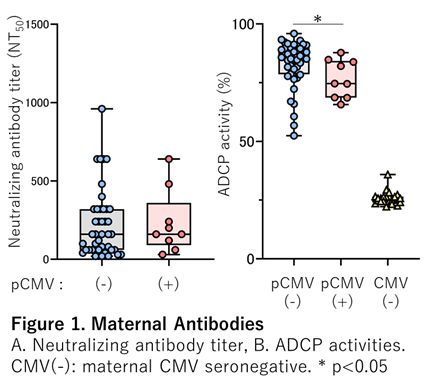
One of the most important findings of our study is the correlation between the antibody dependent cellular phagocytosis (ADCP) and pCMV infection. ADCP is an IgG effector function that mediates antigen phagocytosis via IgG-Fc domain.
While maternal neutralizing antibody titers -- an important IgG function for protection -- were equivalent between pCMV-infected and uninfected cases, maternal ADCP activity was significantly decreased in the pCMV cases (Fig.1).
These findings demonstrate that infant protection depends not just on antibody presence, but on the quality of antibody - specifically, the maternal capability to recruit and activate immune cells for efficient to prevent infection.
Key Finding 2: Identification of Novel Transmission Route and Risk Factor
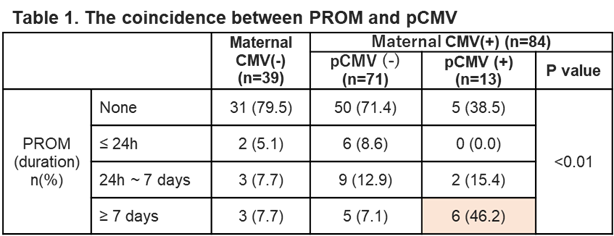
Conventionally, pCMV infection was thought to occur mainly through breast milk transmission. However, our analysis revealed that the prolonged premature rupture of membranes (PROM) exceeding 7 days is a novel risk factor (Table 1). These findings strongly suggest that the occurrence of transmission during the intrapartum period.
Key Finding 3: Clinical Symptom and Neurological Effects of pCMV in Preterm Infants
Neutropenia closely coinciding with viremia, as well as electroencephalographic abnormalities, were frequently observed in preterm infants with pCMV infection. These findings suggest that infection during critical periods of extreme prematurity can adversely affect the central nervous system, underscoring the vital importance of long-term developmental follow-up.
Clinical Significance and Future Perspectives
Through the TOCAI study, we identified some novel risk factors for pCMV infection in preterm infants. These findings enable the early identification of high-risk cases based on maternal ADCP activity and intrapartum conditions. Furthermore, this work paves the way for the development of novel preventive strategies, therapeutic interventions, and pharmaceuticals.
We will continue to drive research to protect precious young lives.
Acknowledgement
We express our deepest gratitude to all the study participants for providing their precious specimens.
This study was supported by the Japan Agency for Medical Research and Development (AMED). We sincerely appreciate their support.
Glossary of Terms
- Cytomegalovirus (CMV): Almost infects asymptomatically in childhood and establishes life-long latency. High prevalence (~70% in Japanese), low pathogenicity in healthy individuals.
-
Antibody-dependent cellular phagocytosis (ADCP): A key IgG effector function where immune cells, such as macrophages, eliminate viruses and infected cells using specific IgG antibodies as a guide.
- Premature rupture of membranes (PROM): Rupture of the amniotic sac before the onset of labor. Antenatal corticosteroids may be administered to promote fetal lung maturation and improve respiratory outcomes.
Reference
Journal: The Journal of Infectious Diseases
Title: Postnatal Cytomegalovirus Infection in Preterm Infants ≤28 Weeks: Maternal IgG Effector Function, Risk Factors, Viral Kinetics in Relation to Symptom Onset, and Clinical Outcomes in a Prospective Multicenter Study
Authors: Sugiyama Y, Koizumi J, Kondo H, Takahashi K, Tanaka R, Suzuki M, Suzuki T, Hattori T, Oshiro M, Sato Y, Hayakawa M, Ito Y, Torii Y, and Koshizuka T.
https://pubmed.ncbi.nlm.nih.gov/42103312/
DOI: 10.1093/infdis/jiag259